

What does gentrification mean, and who gets to decide when it happens to your street?
Imagine Bob. He’s made up, but you can imagine bob’s your uncle if you’d like. Every step of his story below comes from something that really happened in Liverpool. It’s 2009 and Bob owns a small business in the Baltic Triangle. He’s there because the rent is low and the buildings are big. He has no idea yet that the work he and his neighbours are doing will make the ground under him worth far more than the business on top of it.
Over the next dozen or so minute you’ll read as Bob goes through the Baltic, then across the city to Toxteth. While we ask three questions: Who asked for this, Who paid? And who gained? I’m not here to tell you gentrification is good or bad. I’m here to lay out what the record shows, say where it runs out, and leave the verdict to you.
What does gentrification mean?
The word is almost as old as The Beatles. The sociologist Ruth Glass coined it in 1964, in the introduction to London: Aspects of Change, to describe what she saw in Notting Hill and Islington. In her words, “many of the working class quarters of London have been invaded by the middle classes”, and once the process starts it “goes on rapidly until all or most of the original working class occupiers are displaced” (UCL Bartlett). The word was a dry joke at the expense of the gentry.
Strip the 1960s London out of it and the plain meaning is this. A run-down area gets investment and new, well off people. Prices and rents rise. The people and businesses who were there before find it harder to stay.
“Displacement” is the part people argue about, and it comes in at least three forms:
- Direct: people are pushed out by rent rises, evictions, buyouts or clearance.
- Business and cultural: a venue, studio or shop loses its premises because the land is worth more as something else.
- Exclusionary: nobody is pushed out, but people on lower incomes can no longer get in.
That last one matters more than it sounds. The best recent English research, by Mark Fransham (2020), looked at 2010 to 2014. It found the strongest evidence for exclusionary displacement: poverty fell in gentrifying areas mainly because of who moved in, not because existing residents left. It is one study, covering one period, using one dataset, and the author is clear about its limits. The UK evidence on all of this is thinner than other areas like the US, and I’ll keep that in mind as I go.
Bob opens up in the Baltic Triangle
The Baltic Triangle is named after the firms that traded with the Baltic countries, and its warehouses served the docks, which were once served by the Dockers’ Umbrella. The Second World War bombing hit it hard, and by the end of the twentieth century big warehouses such as those on Greenland Street and Heaps Rice Mill stood derelict, according to Historic England’s 2018 case study. Liam Kelly of the Baltic Triangle Area CIC later called it “a desolate red light district wedged between L1 and L8”.
So say Bob rents a unit in one of those old buildings. The rent is low, the space is huge, and nobody else wants it. He’s in good company. From about 2005, live music led by venues such as the New Picket and Elevator Studios began to revive the area, and the A Foundation arts venue opened in 2006. In 2009 Baltic Creative, a community interest company backed by the council, took long leases on about 18 buildings and let small units to digital and creative firms, reinvesting its profits locally. By 2018 it was recording 250 rental enquiries a year and had 80 companies on a waiting list.
The creatives knew what could happen. Historic England notes that creative businesses are drawn by affordable space, that this pattern often leads to gentrification, and that the Baltic’s creative community wanted to avoid it. Port magazine reported in 2014 that rents had risen and a gentrification debate was starting, and a Baltic Creative board member admitted that developers would ultimately “do what they do”. Two years later David Lloyd of the Seven Streets blog was quoted in Big Issue North saying the creatives who revived the area were “at the bottom of the food chain”.
Geographers have a name for what happens next. The rent gap is an idea from the geographer Neil Smith, which Tom Slater explains. In short, it’s the distance between what a piece of land earns now and what it could earn if somebody put it to better use. Stigma helps create the gap, because nobody wants to invest in a place with a bad name. Then somebody does. The Baltic had the stigma, the empty buildings and the cheap rents. Bob and his neighbours were turning it into somewhere people wanted to be, and, as Kelly would argue within a few years, making the land worth more while they did it.
The year the land became valuable
By 2018 the numbers had changed. A later council framework put investment in the area at £128 million since 2012 and said its population had doubled in a decade (Liverpool Express).
In July 2018 the arts and music venue Constellations, open since 2014, said it would close in 2019 so its site could be cleared for residential development. Its statement called the developer, Legacie Developments, “incredibly supportive of our move”, and said its weddings, conferences and festivals would go to a new Baltic Triangle venue, Hinterlands (Getintothis).
Days later Kelly, then a board member of the Baltic Triangle Area CIC, published an open letter. “Sadly, we know that the land has only become viable as a ‘development opportunity’ because of the last five years of work done, community built and joy shared in The Baltic Triangle,” he wrote. He asked for the conversation to move from “how do we build over this?” to “how do we build on this?”
In September 2018 Legacie’s plans for more than 500 apartments off Greenland Street were approved at a planning meeting, after an earlier deferral, over objections from the ward councillor Steve Munby and the Baltic Triangle CIC (The Business Desk). One councillor argued that schemes like it were squeezing out the creative sector.
Nobody in this story is acting in bad faith as far as the record shows. Constellations called its developer supportive, and the council’s stated aim in a 2018 cabinet report was to “protect employment land, support the growth of the digital and creative industries sector” (Place North West).
What Bob does next depends on luck and leases. If he’s a Baltic Creative tenant, he probably stays, because the CIC holds the buildings and keeps them for small firms. If his lease ends and the landlord sells, he might do what Constellations did and move within the area. If he can’t find anywhere, he closes. Kelly’s letter lists venues that had already gone.
The new neighbours changed things too. 24 Kitchen Street, a 400-capacity venue, has been in a long dispute with developers building flats on a car park next door. Kevin McManus, Liverpool’s head of UNESCO City of Music, told Time Out: “Venues are now having to fight for space due to residential developments taking off.” In October 2019 the council moved to adopt the Agent of Change principle, which makes whoever changes a site responsible for managing the impact. In practice, a developer of flats next to an old venue has to deal with the noise problem, instead of the venue being told to turn down (Getintothis).
Who was asked? The ward councillor and the community company objected. The scheme was approved anyway. Who paid, and who gained? Developers gained a site made valuable by years of local work, and the city gained homes. Venues and studios carried the risk. Whose place was it counted as? Officially, the creatives’: the council said it wanted to protect them. In practice, decisions were made one scheme at a time.
Then and now: the Baltic in three snapshots
| 2014 | 2018 | 2025 draft plan | |
|---|---|---|---|
| Space and rents | Cheap, characterful buildings drew creative firms; rents had begun to rise | Baltic Creative running about 18 buildings, with 80 firms on a waiting list | Creative and digital business to be the main use in the area’s core |
| What the rules said | A supportive council; developers expected to “do what they do” | The council planning a framework to “protect employment land” | Homes only above ground floor in the core; affordable ground-floor space for creative and cultural firms |
The Baltic Green
There is one small patch of ground that tests every idea in this piece.
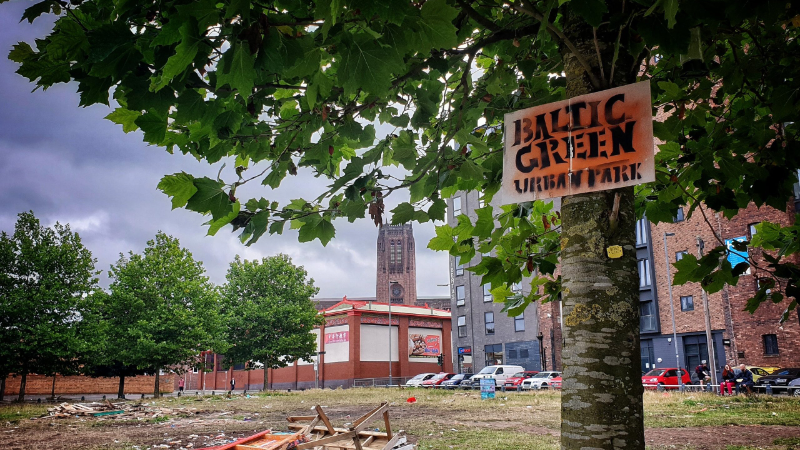
The Baltic Green sits between Kitchen Street, Jamaica Street, St James Street and Bridgewater Street. For years it was mostly unused, and its main job was as a Bonfire Night fire pit for neighbours, according to Engage Liverpool. In January 2020 Tristan Brady-Jacobs, a Baltic Triangle director and a direct neighbour of the site, told Getintothis he wanted it to be a park for workers and for the L1 residents who had no other green space nearby. “This is the last green space in the area and we must protect it,” he said. The council, which owns the land, had given the go-ahead.
Volunteers built pallet seating there. In August 2021 the council cleared it. The Echo reported that pest control officers had found rats nesting in the pallets, and that more people had been eating and drinking there since lockdown ended, which was drawing them. The council had allowed the seating under a land agreement, and said it was forced to act over a risk to human health ([Liverpool Echo, 6 August 2021](LINK NEEDED)).
Brady-Jacobs said the volunteers had always expected the pallets to be temporary and accepted the rats had become hard to deal with, but he was “devastated” by how quickly it was cleared. Councillor Steve Munby said neighbours had complained about people gathering there after leaving licensed premises, and that the council had “a long term vision for this space as a community public space” and would consult people on it.
Engage Liverpool, a community site, took a harder line in September 2021. It said “communication was vague and deficient”, and that “neither the park pledge nor the Section 106 money supposedly allocated to the space ever materialised.” By its account the site was left largely bare and used once a year, on Bonfire Night. I couldn’t find a later update.
Section 106 is the legal bit under all this. When a developer gets planning permission, the council can make them sign an agreement to pay for the effects of the scheme: affordable housing, play areas, trees, green space. The money is agreed up front but often falls due later, before work starts or before people move in.
In his 2018 letter, Kelly asked what had happened to the “£5.24m collected between 2010 and 2016 from developers” for open space, trees and public art. I haven’t found anything that confirms or explains that figure, so treat it as his question, not a finding.
A response to a Freedom of Information request gives a clearer picture of money owed across the city. In January 2023 the council said £4.14m of Section 106 money was outstanding, and that 80% of it related to companies in administration. It can’t chase a firm in administration, but the debts run with the land, so a new owner can be asked to pay. It had recovered £1.23m that way since September 2021 (Liverpool City Council).
That changes the story. Novara Media reported in 2022 that the council was owed nearly £6m, and that a developer who bought council land in the Baltic agreed £1.5m for lost green space but paid about £110,000 before the council waived the rest. That is a campaigning feature’s account, and it doesn’t say which green space. What the council’s own letter shows is less dramatic and more awkward: money meant for communities was stuck because the developers who owed it had gone bust.
The wider picture is no tidier. The Post reported in May 2025 that the council held more than £17m in Section 106 money, with about £12m allocated to projects but not spent. Whether any of it was meant for the Green, nothing I found says.
Who was asked? In 2021 the council promised to consult on the Green’s future. I found no record of what followed. Who paid, and who gained? Volunteers built it. The council’s reasons were rats and neighbours’ complaints. The park the developer promised, by Engage Liverpool’s account, never arrived. Whose place was it counted as? Neighbours who wanted somewhere to sit, and neighbours who wanted to sleep. Both live there.
What the rules say now
The council’s draft Local Plan for 2025 to 2041, first published in September 2025, has a policy just for the Baltic Triangle, CC15. It reads a lot like an answer to Kelly’s letter.
It says the area’s mix of uses should have its “primary focus on creative and digital businesses”. In the creative and digital core, those businesses should be the main use, and homes are allowed only “from the first floor and upwards”. Every scheme must avoid undermining creative and digital firms and follow Agent of Change. Where a scheme includes homes, it must provide ground-floor space “with a focus on providing affordable accommodation for creative and cultural businesses”. Nightlife in mostly residential streets must close at midnight, with later hours allowed around the Jamaica Street and Greenland Street junction and around Stanhope Street. The plan says the Baltic Triangle planning document was adopted in December 2022.
A separate policy, H2, says developments of 10 or more homes must make at least 20% of them affordable: half social rent, a quarter affordable rent and a quarter shared equity, unless a developer can show it makes the scheme unviable. The council’s own figures show why that matters. The draft estimates a need for 2,384 rented affordable homes a year. A 2024 housing strategy said only about 11% of homes built in the previous five years were affordable, with 15,500 households waiting (Place North West).
Two honest limits. It’s a draft, and policy on paper is not the same as what gets built. And the Baltic Green isn’t named anywhere in it.
The cycle moves on
Bob wasn’t the first creative to try this. In the 1990s, Ropewalks was meant to become a creative business district, and Urban Splash’s Tea Factory was completed in 2000. By 2014 the commentator Paul Unger, writing in Place North West, said Ropewalks was “better known for its noisy bars” and the Tea Factory was largely empty, and questioned “repeating the Ropewalks vision a mile away at Baltic”. It’s an opinion piece, but it shows the pattern is not new.
Then the Baltic became the template. The council’s 2017 framework for Ten Streets, in north Liverpool, aimed to regenerate deprived areas such as Kirkdale and to repeat the Baltic’s success (Wikipedia’s summary). The Fabric District, about 86 acres near Lime Street, was endorsed by the council’s cabinet in June 2018 with a vision that followed the Baltic’s model, and student flats have been arriving there since (Place North West).
The question is the same each time, and it’s the one Bob faces: when an area becomes worth investing in, who gets to stay for the payoff?
Bob’s neighbours in Toxteth
The Baltic Triangle sits on the edge of Toxteth, and the streets next door have a different story.
The Welsh Streets are Victorian terraces in Liverpool 8, once judged fit only for demolition. In the 2000s a national programme called Housing Market Renewal paid for clearance in parts of Liverpool. SAVE Britain’s Heritage cites a 2005 council report showing residents of Madryn Street opposed demolition by 35 to 1. The campaign to save the streets did succeed. Nina Edge, one of the campaigners, said: “We turned what was said to be an impossible dream into a reality.”
But not everyone got to stay. Larry Neild, reporting for Liverpool Confidential in 2017, found that many long-standing residents had been evicted or taken payouts. One couple in their late fifties took out a new mortgage of more than £50,000 to bridge the gap. Many moved elsewhere in Dingle and Toxteth, often with new debts, and residents who wanted to return had largely been unable to. The first 24 houses had been renovated, with up to 300 homes planned on an estate of more than 400, at market rents of £650 to £894 a month. The council had handed most of the vacant site to a commercial developer, PlaceFirst, whose Martin Ellerby said the first batch showed “a genuine hole in the market” for restored Victorian terraces.
This isn’t market-led gentrification in the usual sense. Rents didn’t push these residents out. A public clearance programme moved them, and the site was then handed on and renovated for sale and rent. That’s closer to what Glass meant by displacement than to what Fransham’s data picks up, which is the point: one word covers very different things.
Who was asked? Residents, repeatedly, and they said no. The streets were saved in the end. Who paid, and who gained? Some households took on debt. A developer found a gap in the market. Whose place was it counted as? Heritage campaigners called the streets worth saving. The people who had lived there largely couldn’t go back.
The street that refused to leave
The reason Toxteth looks the way it does goes back to 1981. The uprising in Liverpool 8 lasted nine days in July, with about 500 arrests, and is usually remembered as the Toxteth riots. In the years after, shops closed and houses emptied. Ronnie Hughes, remembering Granby, told The Guide Liverpool: “The streets were gradually blighted, gradually emptied.”
Four streets, Beaconsfield, Cairns, Jermyn and Ducie, were what was left. By the Granby Four Streets Community Land Trust’s own account, residents formed an association in 1993 to stop demolition. In 2002 Housing Market Renewal named the Four Streets as a site for clearance, with accusations of “social cleansing”, and SAVE backed the residents. When a change of government cut the programme’s funding in 2010, residents painted derelict houses, brightened shared spaces and started a market. By the end of 2011 they had formed the Trust.
The council’s first attempt, a private contractor in 2012, was ended within about six months. In 2014 the council transferred ten properties to the Trust. Architects Assemble worked with residents and won the Turner Prize in 2015, with judges praising a “ground-up approach to regeneration, city planning and development in opposition to corporate gentrification”. By 2019 the Trust had finished eleven houses (Granby 4 Streets CLT), for affordable rent and ownership, with homes priced against the community’s average income according to Nesta. Tenants were chosen with Steve Biko Housing Association on housing need, and former Granby residents were encouraged to return. Michael Simon, born on Granby Street, said the most successful thing the Trust had done was to “work with organisations that we were once in conflict with”.
Eleven houses is a real achievement and a small number, four decades after the uprising. And success raises its own question: what keeps homes affordable once a neighbourhood becomes fashionable?
Who was asked? Residents asked themselves first, in 1993. The council came round, eventually. Who paid, and who gained? Public and charitable money paid. The homes are priced against local incomes, and former residents were invited back. Whose place was it counted as? For years, a site to be cleared. Then, the residents’ own.
What the numbers can and can’t tell you
The Indices of Deprivation 2025 rank every small area in England on income, work, health, crime, housing and more. I pulled the neighbourhoods that cover the places in this piece, using the Liverpool City Region’s open data release (if you’re not sure what that covers, here’s what the Liverpool City Region is). Decile 1 means the most deprived tenth of England.
| Area | Neighbourhoods checked | Overall decile |
|---|---|---|
| Baltic Triangle | Liverpool 037H and 037G | 2 and 4 |
| Toxteth | Liverpool 044D, 044E and 043D | 1, 1 and 1 |
| Dingle | Liverpool 050B and 050G | 1 and 2 |
| Kirkdale | Liverpool 014E | 1 |
Across the city, 111 of 302 neighbourhoods (37%) sit in the most deprived tenth. The Baltic is mixed rather than deprived. Its neighbourhoods have no ward of their own and include a lot of new flats, so treat them as a guide, not a verdict. These figures also can’t show change over time, because the 2019 index used different boundaries.
For change over time there is the Centre for Cities, which reported in May 2026 that 53.7% of neighbourhoods in Liverpool’s urban area were among the UK’s most deprived in 2025, down from 64.4% in 2010. That was the biggest fall of any UK city. It doesn’t say whether that is residents getting better off or people moving out. That is the whole argument, in one unanswered question.
Rents are missing. The ONS says private rents in Liverpool averaged £897 a month in April 2026, up 6.3% on the year (via HouseCheckup). Median house prices in Liverpool rose from about £117,500 in March 2015 to £150,750 in March 2022, with terraced homes up 44% and flats up 28% (ONS). Those are figures for the whole city. Rents and prices aren’t published for the Baltic, Toxteth or Dingle, so nobody can currently show, with official figures, who is being priced out where. That is a fairness problem in itself, because you can’t have a fair argument if nobody holds the numbers.
What people say online splits too. In one Reddit thread from a couple of years ago, a poster worried that Liverpool would become a copy of London or Manchester. Replies called that hot air and said the real problem was investment stopping ten minutes from the centre, in places like County Road, Anfield and Garston. In another, Dingle was described as on the up, which one commenter read as a polite way of saying the old community would be priced out, while another said Dingle used to be rough and improvement should be welcome.
What seems to protect a place
Look back across the cases and three things keep turning up. They aren’t proof, and each has limits.
Ownership. Baltic Creative’s model and the Granby land trust both keep property in community hands. Mark Lawler of Baltic Creative told City Monitor in 2016 that the difference was “control and ownership”, and warned that “the market is moving faster than the planning.” The limits are scale and competition: Granby is eleven houses, and Novara reports that Baltic Creative bid for council land in the Baltic and was reportedly outbid by private developers.
Rules written in time. Agent of Change and Policy CC15 try to protect existing uses before the pressure arrives. The limits are that CC15 is a draft, and that Liam Naughton, part of the team behind the Kazimier Garden, said of Agent of Change in 2019: “we need it to be seen to be working.”
A say, early. Granby’s residents organised in 1993, long before anybody listened. In the Baltic, the area was designated a Neighbourhood Business Area in 2016 and a forum was drawing up a neighbourhood plan, according to Big Issue North. I haven’t found what became of it. In 2020 the then mayor, Joe Anderson, said consultation with businesses and residents would be “crucial”.
None of that tells you what’s right. It tells you what was different in the places where people stayed.
The question I’m left with
Bob, remember, is made up. The Baltic Green is real.
So what does gentrification mean in Liverpool? It means a series of decisions about who gets asked, who pays and who benefits, and whose place it’s counted as. Sometimes those decisions are made by developers and sometimes by councils, and sometimes, as in Granby, by residents who simply wouldn’t leave. The missing rent figures and the unanswered Centre for Cities question mean I can’t give you a verdict, and I don’t think anyone can yet.
What I can give you are the questions. The next time someone says an area is on the up, ask them who was asked, who paid, and whose place it was.
Sources
- Ruth Glass, quoted by UCL Bartlett
- Fransham (2020), Population, Space and Place
- Slater (2017), Clarifying Neil Smith’s rent gap theory
- Historic England: Baltic Triangle case study
- Port magazine, 2014; Big Issue North, 2016; City Monitor, 2016
- Liam Kelly, open letter, The Double Negative, 16 July 2018
- Getintothis on Constellations, 2018; on Agent of Change, 2019; on the Baltic Green, 2020
- The Business Desk, 2018; Place North West, 2018
- Liverpool Express, 2020
- Time Out, 2022
- Engage Liverpool, 2021
- Liverpool City Council FOI response, January 2023; The Post, May 2025; Novara Media, 2022
- Liverpool draft Local Plan 2025-2041; Place North West on the housing strategy, 2024
- Place North West, Ropewalks 2.0; Ten Streets; Fabric District
- SAVE Britain’s Heritage, 2011; Liverpool Confidential, 2017
- The Guide Liverpool; Granby 4 Streets CLT history and housing page; Nesta
- English Indices of Deprivation 2025, LCR Digital Commons; Centre for Cities, May 2026; ONS rents via HouseCheckup; ONS house prices
- Reddit threads on r/Liverpool (paraphrased, not quoted)

This article is mentioned elsewhere