

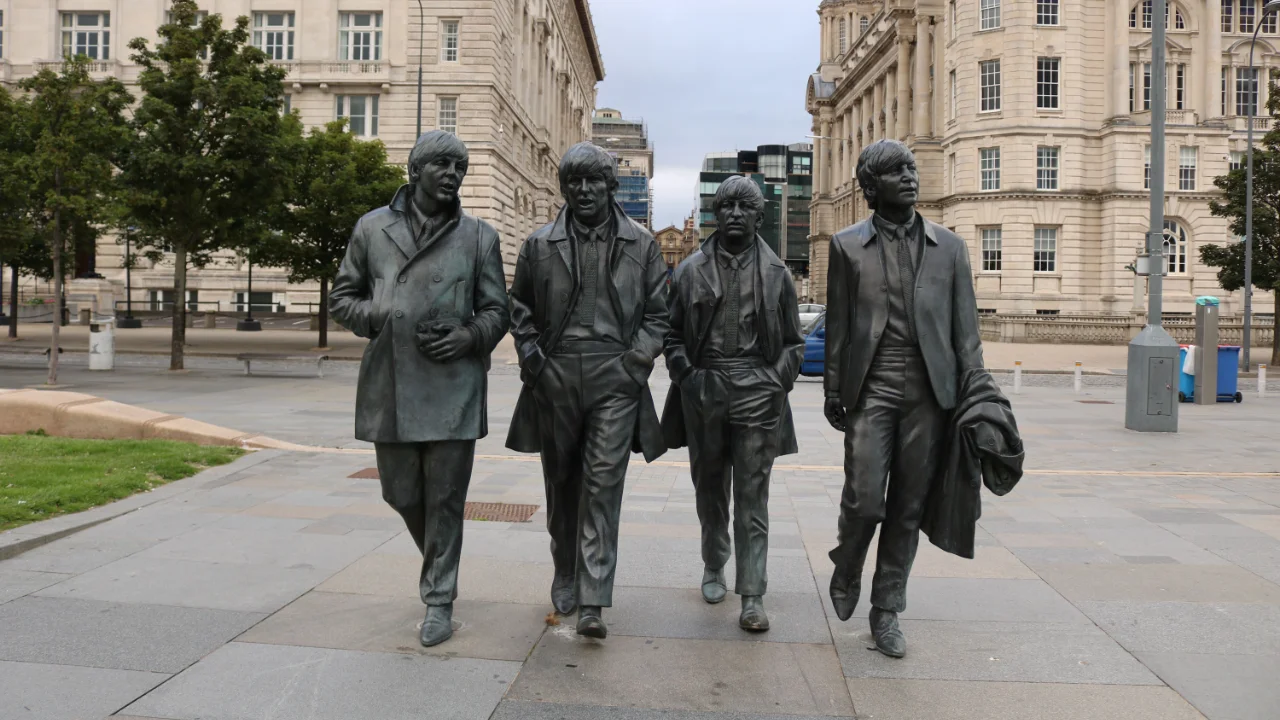
Why don’t the Beatles sound Scouse?
An American Beatles fan asked the question best. He loves the band, ended up supporting Liverpool FC because of them, and one thing has always puzzled him: John and Paul sound nothing like Jamie Carragher. Listen to a 1960s Beatles interview and then to a modern Scouser, The Beatles are Scouse, but they barely seem to share an accent. So what happened?
The answer turns out to be the most interesting thing about the Scouse accent. While most of Britain’s regional voices have been quietly softening, Liverpool’s has been doing the opposite. It got stronger.
Is there one Scouse accent? Not really
Start by taking the question apart, because it assumes there is a single Scouse sound to measure the Beatles against, and there isn’t. Scouse is a spectrum, not a setting.
The clearest divide is north and south. The north end of the city, Kirkdale, Bootle, Anfield, tends toward the harder, sharper accent you would recognise from Carragher or Steven Gerrard. The south end, where the Beatles grew up in Allerton and Woolton, has always been softer and more sing-song. People who know the city can place a stranger to within a few streets, and the giveaways are tiny: the way “Thursday” lands near “Tirsdee” in the north and softer in the south.
But, and this matters, both ends are unmistakably Scouse today. The difference is softer versus harder within one accent, not Scouse versus not. So the Beatles aren’t speaking a different language from modern Liverpool. They are sitting at the gentle end of a range that has, over sixty years, shifted toward the hard end.
Where the Scouse accent comes from: Irish, Welsh and the docks

To understand why it sounds the way it does, you have to go back to the port that built the city. Before the nineteenth century, Liverpool sounded much like the rest of Lancashire. It was mass immigration through the docks that created something new: the Irish above all, arriving in their hundreds of thousands during the Famine, the Welsh in huge numbers, and Lancashire, Scottish and Scandinavian voices in the mix. Out of that churn came an accent once summed up as one part Irish, one part Welsh and one part head cold. The city took its very name from the same melting pot.
Two things make it distinctive, and neither is volume. The first is the consonants, especially the Scouse “k”. Say “chicken” or “back” like a Scouser and the hard “k” softens into a scraping, almost Welsh-sounding fricative, a sound that is rare in English but common in other languages. The second is the prosody: where most English accents stay fairly flat, Scouse rises and falls in pitch across a sentence, which is why people often read Scousers as more emotive than they mean to be. Add the speed, words run together and clipped, and an ear that isn’t tuned to it stumbles. Tellingly, the sounds that trip up English listeners are familiar to others. Dutch speakers often find Scouse easier to follow than softer English accents, because those guttural sounds exist in their own language too.
Why the Beatles sound softer than Jamie Carragher
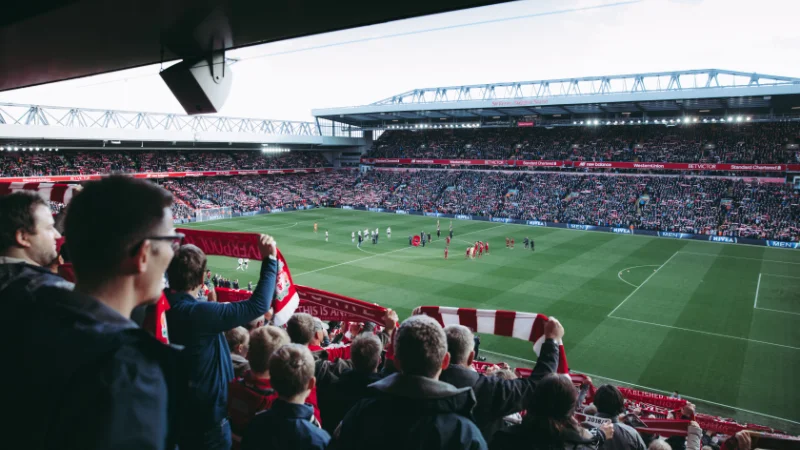
So why are the Beatles soft? Two reasons stacked on top of each other, and a third for luck.
First, class and geography. The Beatles were south-enders, from the more middle-class half of the city that has always spoken more gently. John Lennon and Paul McCartney went to grammar schools, and Lennon was raised by his Aunt Mimi to be well-spoken, so much so that she reportedly thought his Scouse was exaggerated, a bit put on. Carragher and Gerrard are north-end and working class, Bootle and Huyton, where the scouse accent runs harder.
Second, and this is the part people miss, the soft “Beatles” accent has faded even inside Liverpool. It survives now mostly among older Scousers, the sixty-and-over generation. Ask around and the pattern is everywhere: people describe a nan or a grandad who sounded like the Beatles, and date the arrival of the harder, throatier accent to the youth of the 1980s, who are themselves in their forties and fifties now. So the Beatles don’t only sound soft because they were south-end. They sound soft because they belonged to a generation whose accent has since receded as the hard version took over. You are hearing the change itself.
Third, fame sanded their edges. The music industry was in London, so they left young; they spent formative time in Hamburg; and the BBC and a worldwide audience did the rest. They also code-switched constantly, speaking Scouse but singing in something close to American, with Liverpool only creeping back into looser later tracks like “Maggie Mae” and “Polythene Pam“.
Has the Scouse accent got stronger?
Here is the claim the whole piece rests on, and it is genuinely counterintuitive. Across Britain, regional accents have been levelling out for decades, softened by mass media, mobility and the slow spread of Estuary English from the south-east. Liverpool went the other way.
The irony is that nobody saw it coming. In 1999, a Liverpool University expert warned that Scouse was being swamped by Estuary English among the under-thirties, that young Scousers were starting to say “fink” and “bruvver” like Londoners. The prediction was that the liverpool accent would fade into the national mush. It did the opposite.
The linguist Kevin Watson, who has studied Scouse more closely than anyone, gave a later paper the perfect title: “Is Scouse getting Scouser?” His answer was broadly yes. Young Liverpudlians use more local features than their parents, not fewer, and the city is diverging from its neighbours rather than converging with them, resisting the changes sweeping the rest of England, including the glottal stop you now hear almost everywhere else. The accent has even been spreading outward, pushing its features into the Wirral and, by some accounts, as far as Bangor.
How much has it really changed?
Now the honest caveat, because the question quietly smuggles in two different things, and the credible answer keeps them apart.
Some of the gap between the Beatles and Carragher is real hardening: the genuine, measurable shift toward stronger local features that Watson documents. But some of it is an illusion of comparison, setting a soft 1960s south-end accent against a hard modern north-end one. They were never the same starting point, so part of what sounds like sixty years of change is really just the distance between two ends of the city.
It is also worth resisting the tidy origin story you sometimes hear, that the hard accent was “invented” by Brookside in the 1980s, or by a particular gangster film. Televised, proud, hard Scouse arriving in that decade almost certainly amplified the trend, but accents don’t get switched on by a soap opera. Intensification is slow, collective and mostly unconscious. Nobody decided to do it. It happened.
Why Scouse is a badge, not just an accent
So why would an accent dig in while everyone else’s erodes? The answer is the key to the whole thing, and linguists have a name for it: covert prestige.
Nationally, Scouse has long been near the bottom of the pile. Listeners across Britain have rated it coarse, low-status and unattractive for decades. But inside Liverpool the same accent carries the opposite charge: it is a principal marker of local identity and belonging, something to be proud of rather than ashamed of. And that is exactly the condition under which an accent strengthens. Where other cities felt embarrassment and softened, Liverpool felt pride and doubled down. The Beatles helped seed that pride, turning Scouse, for a moment in the sixties, into the apex of cool.
Once an accent becomes a badge of belonging, it also becomes a border, and the city polices that border relentlessly. It is the same logic that decides who counts as a proper Scouser and who is a “wool”: the colour of your bins, which side of a boundary you were born, how you say a handful of words. And the rule of thumb is revealing. The people who lay the accent on thickest are often not from the dead centre of the city at all, but from its edges, where belonging has to be proved rather than assumed. The scouse accent intensifies hardest exactly where the membership is least secure.
Scouse accent discrimination: the price of sounding like this
There is a cost to all this, and it is the flip side of the pride. An accent that works as a badge at home works against you elsewhere.
The research is blunt. As far back as 2006, more than three-quarters of UK employers admitted discriminating against candidates based on accent, and accent is not protected under the Equality Act 2010, which means it can quietly stand in for class discrimination that would be illegal if named directly. The Sutton Trust has found that accents from industrial cities like Liverpool rank at the bottom for prestige, and that these attitudes have barely shifted in fifty years. A 2024 University of Cambridge study went further still, finding the Liverpool accent was among those people most readily associate with sounding criminal, while received pronunciation was thought the least.
Ask Scousers and the studies come alive. The same story repeats: professionals, doctors and teachers and physios working in Liverpool, told by seniors to “tone it down” so that patients or pupils can supposedly understand them, with no actual complaints behind the instruction. Bank and call-centre staff whose strong accents led customers to assume they were scammers, refusing to believe a Scouser could really work in fraud prevention. And almost everyone describes a “phone voice”, a softer, code-switched version of themselves kept for interviews and strangers. The honest nuance is that some of that softening is genuinely about being understood across cities and countries, not pure prejudice. But a great deal of it is the prejudice the research describes, dressed up as a concern about clarity.
And here is where the loop closes. Being judged for the accent is part of why people defend it so fiercely. The contempt feeds the pride, the pride feeds the accent, and the accent gets stronger. Discrimination hasn’t softened Scouse. If anything, it has helped harden it.
So, why don’t the Beatles sound Scouse?
For three reasons stacked together: they came from the softer south end, they belonged to a generation whose gentle accent has since receded, and fame and distance smoothed what was left.
But the deeper answer is the one the whole story has been building toward. Modern Liverpool sounds harder than the Beatles because, here and almost nowhere else, the accent became something worth defending. As the rest of the country smoothed itself out, Liverpool leaned in, precisely because the way it speaks is bound up with who it is. The Beatles were never really the answer to the question. They are just the way in to it.


This article is mentioned elsewhere