

Liverpool once built the first elevated electric railway in the world. Then, after sixty years, it pulled it down. Ask around the city and you’ll find it still hasn’t quite forgiven itself.
A railway you could walk under
For more than six decades, an electric railway ran on iron viaducts above the dock road, the length of the waterfront, carrying workers to and from the docks. Everyone knew it as the Dockers’ Umbrella, and locals had a shorter name still: “the Ovee”.
Why “umbrella” is a small mystery with two answers. The usual one is simple: so much of the line was raised up on its viaduct that dockers could walk along beneath it, sheltered from the worst of Liverpool’s weather. The other, bleaker version, the one told in Helen Forrester’s memoir of the city’s hard years, is that casual dockers stood underneath it waiting to be picked for a day’s work, and it kept the rain off while they waited to find out whether they would earn that week. Both stories still get passed around. Take your pick.
A string of world firsts
What gets forgotten is how genuinely pioneering the thing was. When it opened in 1893, the Liverpool Overhead Railway was the first electric elevated railway anywhere in the world, and the second-oldest electric metro of any kind, behind only London’s first deep tube. It was the first railway to use automatic signalling, the first with electric colour-light signals, and it ran the first electric multiple units ever built, the direct ancestors of nearly every commuter train you’ve sat on since. It even had one of the first passenger escalators at any station.
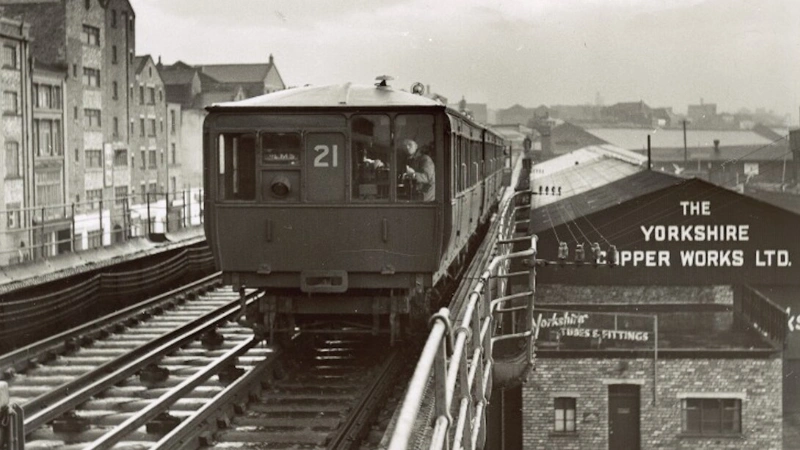
It was electric from the very first day, and for a pointed reason. The dock road was lined with cargo, and sparks or hot ash from a steam engine could have set the lot alight, so the line was designed for electricity from scratch, the first urban railway in the world built that way. It was opened by the Marquess of Salisbury, a former and future prime minister, who switched on the current himself. New York and Chicago had elevated railways too, but theirs began on steam and were electrified later. Liverpool’s was the real thing from the off.
The things people walk past
For something so prominent, it left some odd corners behind. At its southern end the line ran into a tunnel to reach Dingle, which produced the lovely contradiction of going underground to board an overhead train. That same tunnel was the scene of its worst day: in 1901 an electrical fire on a train, fanned by the draught, tore through the Dingle terminus and killed six people, closing the station for over a year.
It also has a quiet place in film history. In 1897 the Lumière brothers filmed the docks from a moving carriage, in what is reckoned to be one of the earliest tracking shots ever captured. The line turns up in later films too, and in archive footage in Terence Davies’s Liverpool memoir Of Time and the City, which is part of why those old clips hit so hard: people can still watch the thing running.
Why it went, and why it wasn’t the council’s fault
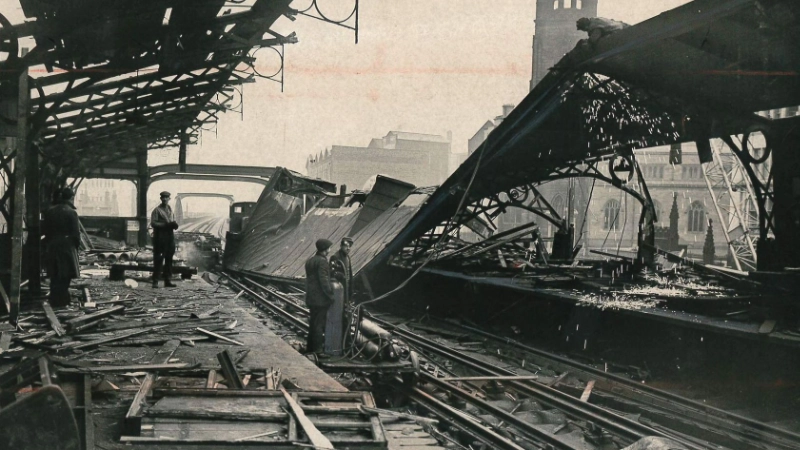
Here is the part that still causes arguments. It had carried dockers through two world wars, taken heavy bomb damage in the May Blitz and been patched up time and again, and by 1955 an inspection found the iron structure was badly corroded and needed major repairs, a bill often reckoned at around £2 million, which in 1956 was an enormous sum. The trouble was who would pay it. The railway was privately owned and had not been nationalised in 1948, so there was no government money behind it, and British Railways wouldn’t take on an isolated local line. Passenger numbers were falling too, as the post-war boom faded and dock work began to dry up.
It’s worth being straight about this, because the lazy version blames the council for knocking it down. It didn’t. The company appealed to the City Council and the dock board for help, none was found, and despite real public protest the Liverpool Overhead Railway closed on 30 December 1956 and was dismantled over the following year. Nobody bulldozed it out of spite. There simply wasn’t the money, and no one whose job it might have been to find it did.
So was it worth saving?
Not everyone mourns it, and the honest answer is more complicated than the nostalgia suggests. It was, first and last, a workers’ railway, built to move dockers along a waterfront that was about to change beyond recognition. By the 1960s that workforce was shrinking fast, the line was expensive to keep standing, and the modern Merseyrail network now runs more or less the same route underground. Put coldly, you can make a strong case that its time was simply up.
And yet. It was a world first, a one-of-a-kind ride high above the river and the ships, and when it went, nothing took its place. That is the thing the romantics hold onto, and they’re not wrong either. Even if every line in the ledger added up, losing something that singular leaves a mark, and a city is allowed to grieve a thing it couldn’t afford to keep. Both can be true at once.
What’s left
More survives than you’d think, if you know where to look. One original carriage sits in the Museum of Liverpool at the Pier Head, raised up to roughly its old height so you can stand under it one more time. Some of the rails were saved. And down at Princes Dock, the metal stumps still set into the dock wall are cut-off stanchions from the railway, left where they were sheared off when it came down.
The eeriest remnant is at the southern end. The old tunnel that carried the line to Dingle still runs through Toxteth, and part of it sits directly above the modern Merseyrail tracks. So next time you’re on the train between Brunswick and St Michael’s, spare a thought for the fact that a few inches above your head is a disused, privately owned Victorian railway tunnel, the last hidden space of a line the city let go.
A first the city had, and lost
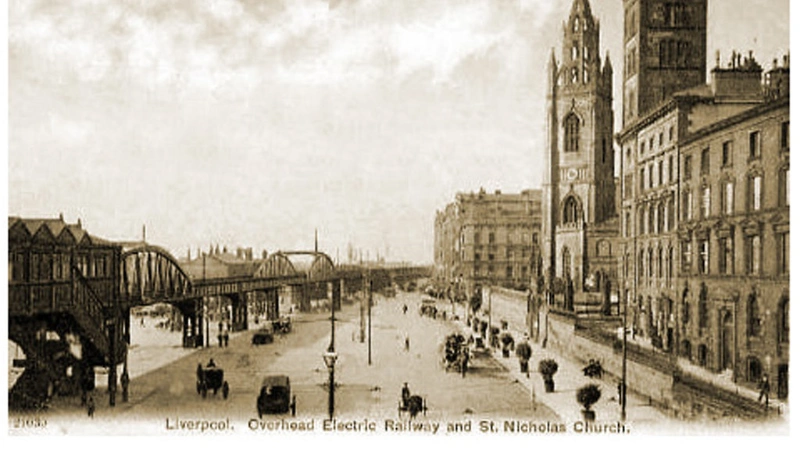
The Dockers’ Umbrella is the thing Liverpool can’t quite forgive itself for. Every few years someone floats bringing it back, usually as a sleek waterfront monorail, and you can hear in the idea how much people wish it had never gone. It is a strange kind of civic grief: not for a cathedral or a great hall, but for a workaday railway that happened to be the first of its kind in the world, ran for sixty years over the heads of the men it served, and then quietly disappeared, leaving a few iron stumps in a dock wall and a single carriage under a museum roof.

This article is mentioned elsewhere