
The Bombed Out Church
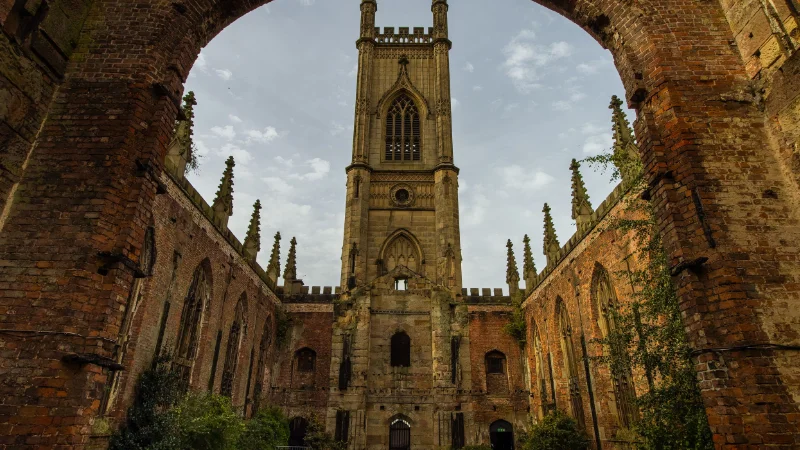
Ask a Scouser to meet you at St Luke’s and you’ll get a blank look. Ask them to meet you at the bombed out church and they’ll know exactly where you mean: the top of Bold Street, the corner with the railings, the one with no roof. Plenty of people who have lived here their whole lives only half-realise it has another name at all, and there’s a running joke that the only people who call it St Luke’s are wools. It is one of the most recognisable places in the city, and one of the least understood.
A landmark you navigate by
Before any of the history, this is what the bombed out church actually is to Liverpool: a fixed point. People measure where they are on a night out by how far they are from it, and use its steps as the spot to stand and call a cab home. There always seems to be someone sat on those steps. It is less a monument you visit than a piece of the city’s furniture, walked past ten thousand times, the kind of place you stop seeing precisely because it is always there.
History: A church that was also a concert hall
The building is older and grander than the ruin lets on. Officially it is the Church of St Luke, and it was built slowly between 1811 and 1832, designed by John Foster senior and his son, the father-and-son surveyors to the old Corporation of Liverpool. And it was never meant to be only a church: the plans were changed mid-build so it could double as a concert hall, and it served as one of the city’s main venues right up until the Philharmonic Hall opened in 1849.
It was known as “the doctor’s church,” because it stood so close to Rodney Street and its rows of physicians. And despite looking every inch like a graveyard church, nobody is buried there: the ground was never used for burials, and was laid out as a garden in 1885.
The night it burned
Then came the war. On 6 May 1941, during the week of relentless bombing Liverpool remembers as the May Blitz, an incendiary device hit the church and set it ablaze. The roof and the interior went, the eight bells fell from the tower or cracked in the heat, and the organ and clock were destroyed. What was left was the sandstone shell that stands today.
Here is the part worth holding onto, because it answers the question every visitor eventually asks. The church wasn’t left as a ruin by accident or neglect. After the war there were proposals to clear the site completely, one of them to drive a new road through it, but in the 1950s the Bishop of Liverpool argued it should be kept exactly as the bomb left it, as a memorial to the people of Liverpool killed in the war. The shell isn’t a building nobody got round to fixing. It is the point.
The things people walk past
For somewhere so familiar, it hides a few genuine surprises. Inside the tower is a cast-iron bell frame from 1828 that is reckoned to be the first metal bell frame made anywhere in the world. Beneath the church is a crypt, closed to the public, and one of its windows holds a stained-glass Liver bird, which some locals will swear is the oldest image of the bird going, though that one is harder to stand up.
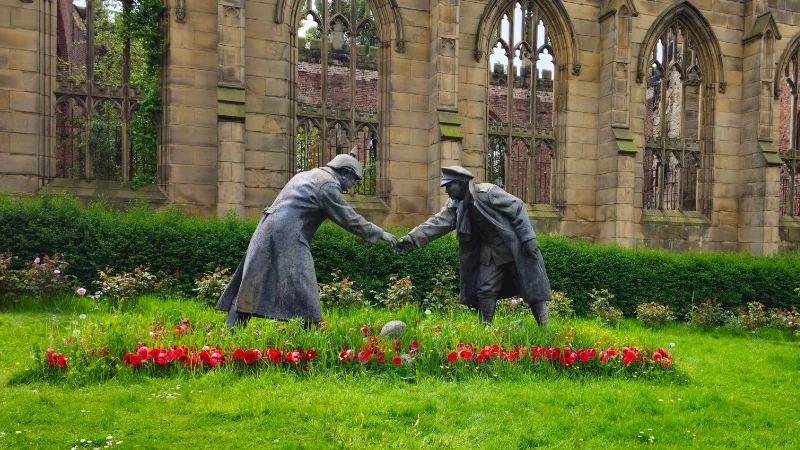
The grounds hold two memorials worth a look: the Irish Famine Memorial, a quiet link to the wave of Irish migration that helped shape the city in the first place, and “All Together Now”, a bronze of the 1914 Christmas Truce by sculptor Andy Edwards, added in 2014 for the centenary of the truce. It shows a British and a German soldier shaking hands over a football.
Gin festivals in a war memorial
For years the bombed out church was a beautiful problem: a listed ruin with no money to run it, its stonework crumbling and propped up with metal supports, locked up more often than not. That changed when a community organisation took it on, and it has been open and alive ever since, because the thing that pays for the day-to-day upkeep is events. Gigs, markets, film screenings, weddings, a bar and garden in the summer, and yes, the gin festivals.
That tradeoff splits opinion – some find it a bit much, a war memorial hosting an outdoor screening of Dirty Dancing and a gin tent? You can see the point. But the people who run it, and most who think it through, land on the same answer: the events are exactly why the doors are open at all.
Before the revenue came in, the place was shut and slowly going to seed. Now it is full of people. Put like that, an open church full of life beats a locked one falling apart, and it certainly beats the alternative everyone dreads, the land flattened for another block of student flats or other concrete monstrosity. The grounds, after all, can only ever be a church. That was the condition the land was given on back in 1791.
Why it matters
The bombed out church is, in the end, one of the most Liverpool things in Liverpool. The city didn’t tear it down and it didn’t tidily rebuild it. It left the wound open on purpose, kept it standing for eighty years as a roofless reminder, and then quietly filled it back up with weddings and gigs and people sat on the steps. A ruin that refused to die, and a memorial nobody has to be told to respect, because they have been walking past it, and meeting their mates outside it, their whole lives.