

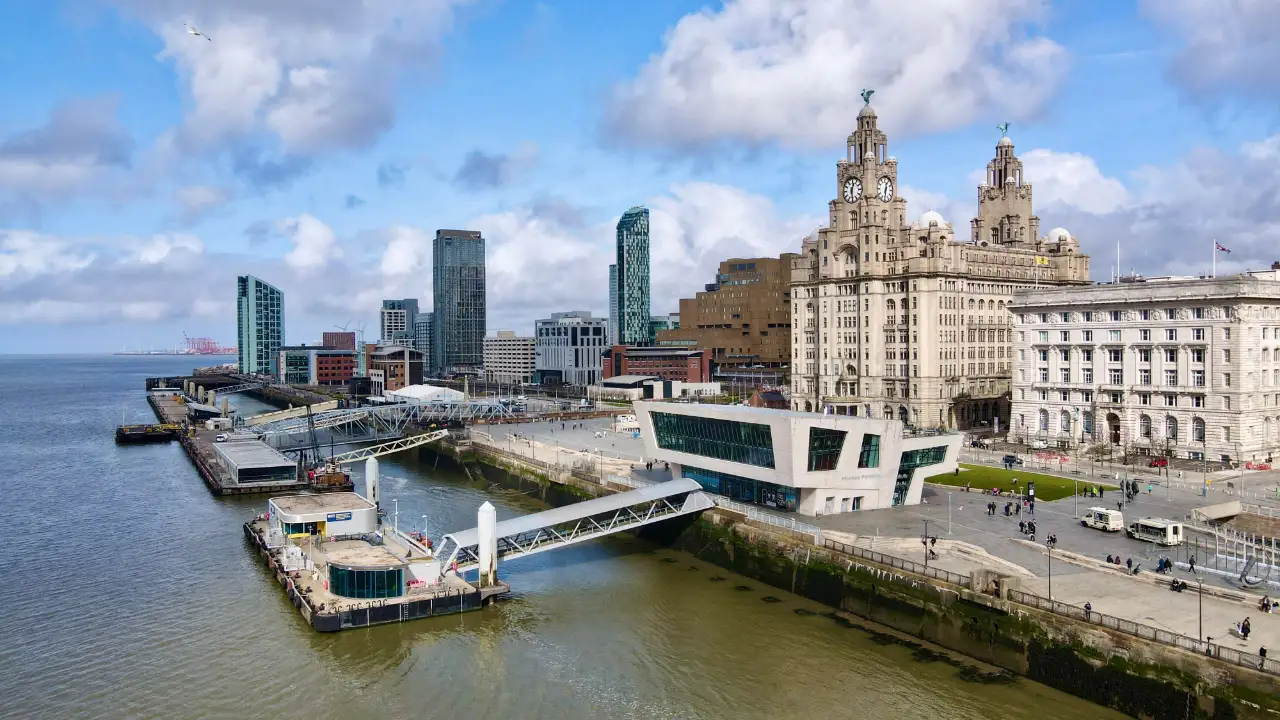
Liverpool is named after a muddy pool. The longer story of how that pool became one of the great cities of the world is really the story of a port, and of everyone who came through it.
A king’s shortcut to Ireland
The city actually has a birthday. On 28 August 1207, King John issued letters patent advertising a new borough at “Livpul” and inviting settlers to come and take up plots of land. The name was already old by then, recorded around 1190 as Liuerpul, from the Old English for muddy water and a pool or creek. It pointed to the tidal inlet, “the Pool,” that once cut into what is now the city centre. John’s motives were not romantic. The natural harbour gave him a handy place to ship men and supplies over to his campaigns in Ireland. The irony being Liverpool would become a home-from-home for many Irish people.
What king John laid out was tiny: seven streets in the shape of an H, names that survive today as Water Street, Castle Street, Chapel Street, Dale Street, High Street, Tithebarn Street and Old Hall Street, with High Street as the crossbar. A castle followed around 1235.
Five centuries of not very much
And then, for a long time, almost nothing happened. The first count in 1272 found 840 people; by 1300 it had reached perhaps a thousand, and there it more or less stuck. Plague, war and a larger neighbour in Chester kept it a modest fishing and trading town for some four hundred years, and it was fought over three times during the Civil War sieges of the 1640s. As late as 1700 only around 5,700 people lived there. For half a millennium, the muddy pool was a backwater.
The dock that changed everything
The turn came from the water. As the River Dee silted up and strangled Chester’s trade, and as English commerce swung towards Africa and the Americas, Liverpool’s deep, sheltered position suddenly mattered. In 1715 the town opened the world’s first commercial enclosed wet dock, a piece of engineering that let ships load and unload whatever the tide was doing. It was the hinge on which everything turned. From a few thousand people, Liverpool began its climb towards becoming one of the busiest ports on earth.
The wealth and the wound
That climb has to be told honestly, because a great deal of it was built on the transatlantic slave trade. The first Liverpool slaving voyage sailed in the 1690s, but the business exploded after 1740, when the town’s merchants overtook London and Bristol to dominate it. By the end of the eighteenth century Liverpool accounted for around 46 per cent of the entire transatlantic slave trade, and in the final years before abolition roughly four out of five British slaving voyages left from the Mersey. Across the whole period its ships carried an estimated 1.17 million enslaved Africans to the Americas, more than any other port in the country, which earned the place the grim title of “the metropolis of slavery.”
The profits did not stay at sea. They built docks, banks, insurance houses, and fine streets seeded the fortunes of merchant families who became the town’s mayors and MPs. they laid much of the financial foundation the later city stood on. When the trade was abolished in 1807, that accumulated capital simply pivoted into other cargo. It is not a footnote to Liverpool’s rise. It is a load-bearing part of it.
Then the world arrived
What came next made the population as well as the money. Through the nineteenth century the port handled cotton, sugar and tobacco, and an enormous traffic in human emigration, the millions passing through on their way to the New World. In all that churn, people stayed, and others arrived, until Liverpool became one of the most mixed cities in Britain.
The Irish came in the greatest numbers, above all during the Great Famine. Around 280,000 landed in 1846 and close to 300,000 in 1847 alone, briefly more than doubling the size of the town. Many meant only to pass through to America but ran out of money, fell ill or were preyed upon, and stayed; by the 1851 census, close to a quarter of Liverpool was Irish-born. The Welsh came in such numbers for work that Welsh builders put up whole districts of the city. Chinese seamen, taken on by the Blue Funnel Line for its runs to the Far East from the 1860s, settled by the docks and founded what is now the oldest Chinese community in Europe. And rooted in the slave trade and the African seafaring that followed it, Liverpool grew Britain’s oldest Black community, established from the 1730s, with families who trace their Liverpool heritage back ten generations. German, Scandinavian and Italian communities formed the same way, deposited by the trade routes.
The front door of industrial Britain
As the country industrialised, Liverpool found its defining role, and it was not as a city of factories. It was the port that fed and emptied them. The north-west was the engine room of the Industrial Revolution, and Liverpool was its main door: the nation’s chief port for raw cotton, which came in across its quays bound for the Lancashire mills, with the finished cloth carried back to the same docks for export to the world. Much of that cotton, especially in the early decades, was grown by enslaved people on plantations in the American South, a grim thread of continuity that ran on for years after Britain had abolished its own slave trade.
That link between port and mill was made literal in 1830, when the Liverpool and Manchester Railway opened: the world’s first inter-city railway, the first to run entirely on steam locomotives to a proper timetable, built to move cotton and goods between the docks and the factories faster than the canals and rutted roads could manage. It worked, and it lit the fuse on the railway age that spread from here across the world.
The city the port made
So Liverpool was founded twice. Once in 1207, as a king’s muddy little harbour with seven streets and a few hundred souls. And again, across the following centuries, by the sea itself, which brought the wealth, a wounding scar, and above all the people. Everything that makes the place recognisable, the food, the accent, the character, came up the Mersey on the tide. It is a city assembled, for better and for worse, out of everything the world sent through its docks.

This article is mentioned elsewhere